Tel: +1 (832) 555-0147 Email: [email protected]

Howden AeroFlow Ventilation Solutions by Industry

Application-specific airflow engineering backed by thousands of installations across six core industry sectors.

Power generation plant

Power Generation

Forced draft (FD), induced draft (ID), and primary air (PA) fans for thermal power plants from 50 MW to 1,000+ MW capacity. Our axial and centrifugal fans handle flue gas temperatures to 450°C with erosion-resistant linings for high-ash coal applications.

  • Adjustable-pitch axial fans for load-following operation
  • VFD-driven centrifugal fans for continuous efficiency optimization
  • Gas-tight damper systems for safe boiler isolation
  • Compliance with NFPA 85 combustion safety standards
Discuss Power Plant Requirements
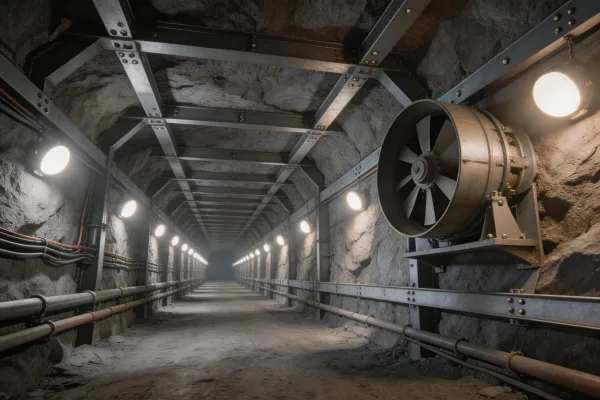
Mine ventilation system

Mining & Tunneling

Main surface fans and auxiliary underground fans designed for the extreme demands of mine ventilation. ATEX-certified for potentially explosive atmospheres with reversible airflow capability for emergency smoke extraction.

  • Main fans to 600,000+ m³/h for deep underground mines
  • ATEX Directive 2014/34/EU Zone 1 / Zone 2 certification
  • Remote monitoring with automated airflow reversal
  • Jet fans for road tunnel longitudinal ventilation
Discuss Mining Ventilation
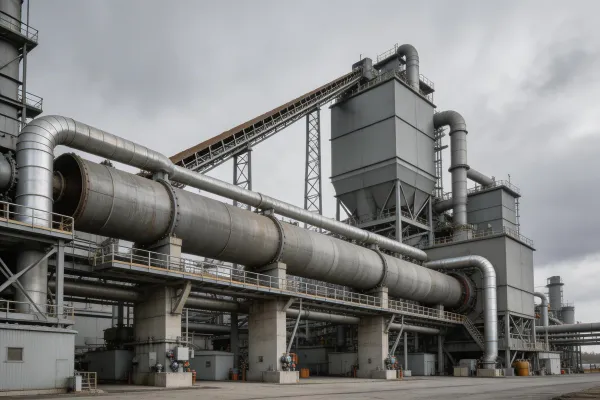
Cement plant with ventilation systems

Cement & Steel

Process fans for kiln exhaust gas handling, raw mill air sweep, clinker cooler exhaust, and pollution control systems. Impellers engineered with abrasion-resistant materials for high-dust-load gas streams.

  • Kiln ID fans rated to 400°C continuous, 500°C transient
  • Tungsten carbide overlay on leading edges and wear surfaces
  • Field-replaceable wear liners for rapid turnaround
  • Baghouse and ESP booster fans with corrosion-resistant coatings
Discuss Process Fan Needs
Data center cooling

Data Centers

EC motor fans and VFD-driven plenum fans for computer room air handlers (CRAH), free cooling economizers, and containment aisle systems. Sound pressure levels below 65 dB(A) at 1m for operator comfort in occupied zones.

  • EC fans with integrated speed controllers for N+1 redundancy
  • Hot aisle / cold aisle containment airflow optimization
  • Free cooling fan arrays for PUE improvement to 1.2 or below
  • ASHRAE TC 9.9 compliant environmental control
Discuss Data Center Cooling
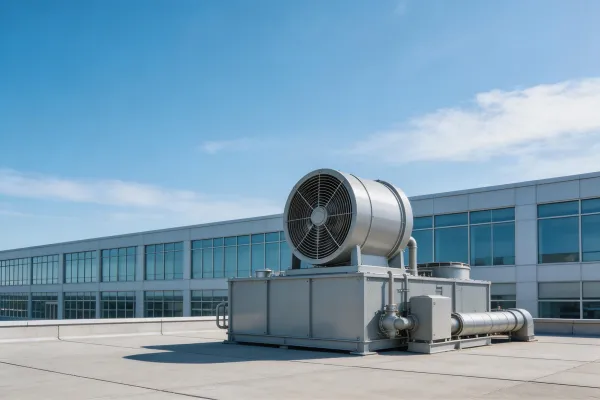
Commercial HVAC system

Commercial HVAC

Supply, return, and exhaust air fans for air handling units, rooftop units, and building pressurization systems. Eurovent and ASHRAE 90.1 certified performance for energy code compliance.

  • Backward-curved centrifugal fans for AHU integration
  • Mixed-flow fans for space-constrained mechanical rooms
  • Smoke extraction fans to EN 12101-3 fire safety standards
  • BACnet/Modbus integration for BMS connectivity
Discuss HVAC Project
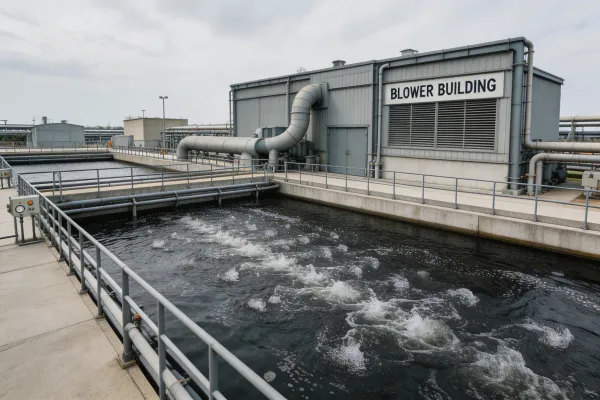
Wastewater treatment blowers

Water & Wastewater

Roots blowers and rotary lobe blowers sized for aeration basin dissolved oxygen demand. VFD control maintains optimal DO levels while minimizing energy consumption — typically the largest single electrical load in a treatment plant.

  • Roots PD blowers from 500 to 50,000 m³/h
  • Oil-free air delivery for biological process protection
  • VFD-based DO control with SCADA integration
  • Sound enclosures meeting 75 dB(A) at 1m boundary
Discuss Water Treatment Project

Centralized vs. Distributed Ventilation: Selecting the Right Architecture

Centralized Fan Stations

A single large fan or redundant fan pair serving multiple zones through a branched duct network. Centralized systems offer higher aerodynamic efficiency (the fan operates at its design point), easier access for maintenance, and lower total installed motor power. The trade-off is higher ductwork cost, longer duct runs increasing pressure losses, and a single point of failure unless N+1 redundancy is specified — adding 40-60% to fan capital cost.

Distributed Fan Arrays

Multiple smaller fans located near their respective zones. This approach reduces ductwork by 50-70%, provides inherent redundancy (one fan failure affects only one zone), and allows phased installation matching construction schedules. However, distributed systems have lower individual fan efficiency, higher total energy consumption at full load, and increased maintenance touchpoints spread across the facility. Total cost of ownership analysis typically favors distributed systems for facilities under 50,000 m³/h total airflow and centralized systems above that threshold.

Don't See Your Industry?

Our engineers have delivered ventilation solutions for petrochemical, marine, food processing, and pharmaceutical facilities. Tell us about your application.

Describe Your Application